

Tech continues to be political & Play is winding down

Raycast introducing Glaze, nothing to declare, the joy of building slow, and more in this week's issue of Creativerly.

My name is Philipp and you are reading Creativerly, the internet corner where I unpack my musings, curate and write about noteworthy apps and software, and explore the latest trends in design and tech.
Hey and welcome to Creativerly 367 👋
Last week I read a post by Robb Knight about making back the switch to Alfred after using Raycast for a while. I have been a long-time Raycast user, but some of the recent features they shipped also got me thinking whether the app still moves in a direction I am fine to continue to support. Just like Robb mentioned in his post, I got tempted by Raycast's shiny and beautiful UI, but also because it offers some lovely integrations. Nevertheless, my main use-case for Raycast is still launching and switching between apps.
The most recent feature they shipped is called Glaze (I am not sure if they checked the Urban Dictionary before deciding that this will be the name). Glaze gives Raycast users the possibility to create desktop apps by chatting with AI, or how Robb Knight called it *"*they're getting into the slop game".
The whole AI hype opened up a lot of doors for both individuals and companies. I could write a whole blog post about the question whether this has been a good or thing. What I am already observing though is that generating code is a loophole, so I am not sure whether it is the right approach to let everyone chat with AI in order to create apps. Glaze has a private team store, so you can share your apps only within your team, but there is also a public store, where you can give anyone access to your apps.
Additionally, this is yet another feature, I have no use-case for. As long as I can use Raycast for simple things like launching and switching between apps, doing some quick translations, or calculations, searching for files,I am thankful for its existence. However, with the introduction of such a major new feature, I am asking myself what the motivation could be. Staying relevant in this AI hype cycle? Convert new subscribers? Attract new investors? And just like this we are entering the waters of why the fundamental problem of modern software is that it is ephemeral. Companies are raising tens or even hundreds of millions, while burning through that money, trying to attract as much subscribers as possible to become profitable and paying back the investors. Or, their "goal" is to get acquired, so the company acquiring the software can shut it down afterwards.
Loads of apps get bloated before they are getting acquired, because the company initially tried everything to stay relevant and convert as much subscribers as possible. I am not saying that this is the case for Raycast, they built something incredibly solid, but recent feature releases drew the impression on my end, that they jumped on some hypetrains. Also, their last investment round was in September 2024. It was a €27M Series B to bring Raycast to Windows and iOS. While the iOS release was a big announcement, it got quiet around that topic pretty quickly, and with an App Store Rating of 2,8 it does not seem like that app had that much of an impact.
Robb Knight’s post, and my own recent reflections, highlight a tension many of us feel as users of modern software: the balance between innovation and bloat, between staying true to core functionality and chasing the next big trend. Raycast’s journey, from its sleek, focused beginnings to its latest AI-driven features like Glaze, mirrors a broader industry pattern where the pressure to grow, attract investment, or simply stay relevant can sometimes overshadow the needs of the user. While I still appreciate Raycast for the simple, everyday tasks it excels at, its recent direction raises questions about the sustainability of software that prioritizes expansion over refinement. In an era where apps can disappear as quickly as they rise, perhaps the most valuable feature of all is one that is increasingly rare: a tool that knows what it is for, and sticks to it. For now, I will keep using Raycast, but with a watchful eye on where its path leads next.
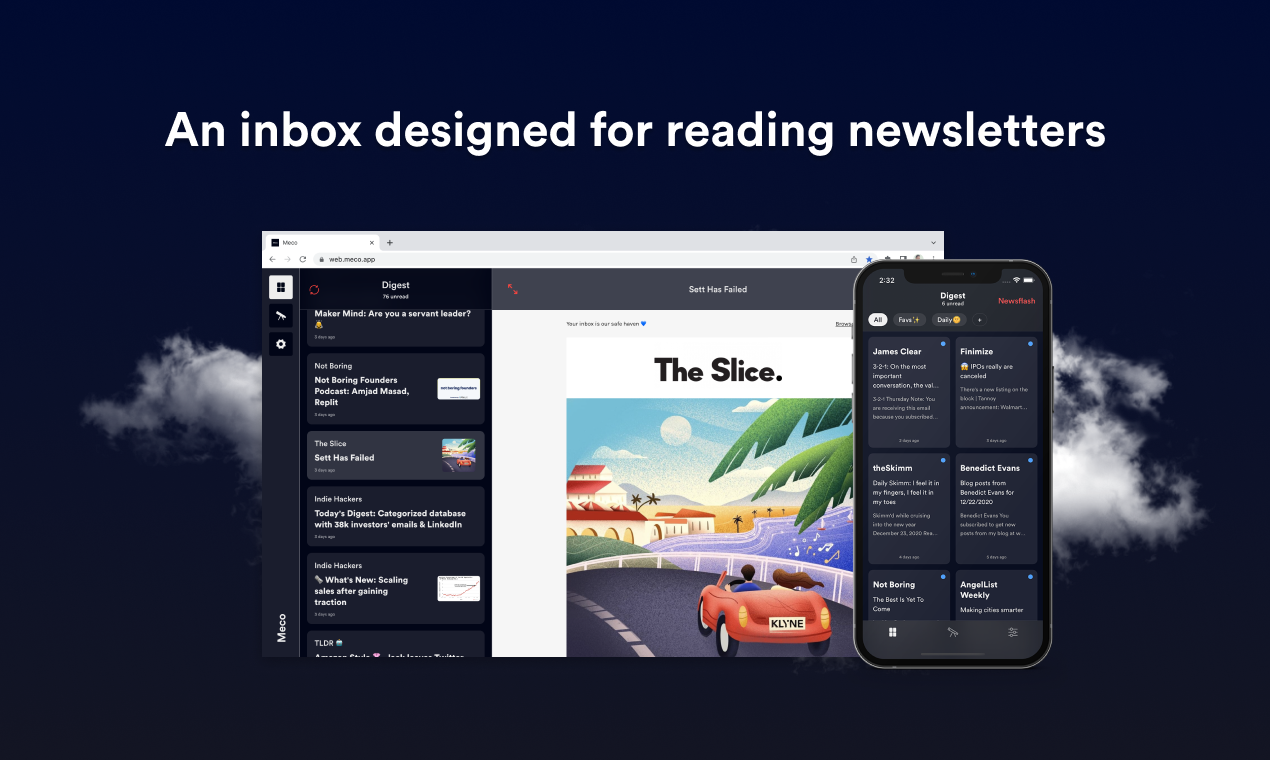
The best new app for newsletter reading.
Meco is a distraction-free space for reading newsletters outside the inbox. The app is completely free and packed with features designed to supercharge your learnings from your favourite writers. Become a more productive reader and cut out the noise with Meco - try the app today!
This is an affiliate link to support Creativerly. If you are interested in putting your tool, product, or resource in front of over 2000 creative minds, consider advertising in Creativerly and book a sponsor or classified ad spot. Find all the important information at creativerly.com/advertise.
Fresh Updates & News
Play is winding down its product to work on something new →
Play, the tool to design, prototype, and ship iOS apps, winner of the 2025 Apple Design Award, just announced that starting April 20, 2026, they will no longer support the Play iOS and macOS apps, ultimately winding down the full product offering. Projects will continue to be editable until April 20, but after that date, users will no longer be able to access them. Play is suggesting to use the macOS simulator in order to record videos of prototypes users would like to preserve, or export Play projects to Xcode using the Play to Xcode SDK. Play's SDK is a package that will remain active after Play is no longer available.
Users who are on paid plans will receive a prorated refund to their original payment method. All account data will be deleted on April 21, 2026. All of this seems to be happening, because the team at Play started to work on something new, as the headline is implying on the linked website.
Mental Wealth
❯ Nothing to Declare – “Making big public statements is always fun and people who think themselves to be important love doing it as a way of trying to influence public opinion and/or politics. They are a way for institutions and individuals to organize and try to shine some light onto important issues.”
❯ Claude magic – “Anthropic’s Claude models are having a moment. Their newest release supposedly “changes everything” and if you don’t use it every day you just cannot have any opinion on LLMs.”
❯ The Joy of Building Slow – “Five years ago, we pushed the first !Boring apps out into the world. I had sold my first company and left my cushy job to confront an underlying tension in software: #1 We were using more and more software and #2 it was making us miserable. Yet most software designers seemed resigned to live with the dissonance—telling ourselves we’re doing good for the world while slowly enshittifying it.”
❯ Tech continues to be political – “Being “in tech” in 2025 is depressing, and if I’m going to stick around, I need to remember why I’m here.”
Do not miss out on this ...
❉ Experience the ultimate vector editor for macOS, iOS, and iPadOS. Get started with Amadine*.
❉ Think tasks, not apps. Setapp* is you one-stop subscription to solving every task on Mac and iPhone.
❉ Fathom is cookie-free, GDPR compliant, privacy-first website analytics software. Get $10 off your first invoice and a 7-day free trial when you use this link*.
These are paid promotions or affiliate links to support Creativerly. If you are interested in putting your tool, product, or resource in front of over 2000 creative minds, consider advertising in Creativerly and book a sponsor or classified ad spot. Find all the important information at creativerly.com/advertise.
Appendix
❯ ICYMI
In the seven part of my series Tiny macOS utility apps I love, I am featuring a simple and powerful note app, and two apps to keep track of system activity.
❯ Quick Bits
- California colleges spend millions on faulty AI systems: 'The chatbot is outdated’ (Martin Romero / The Markup)
- Oracle drops after report that it and OpenAI scrapped plans to expand a data center site in Texas (Luke Kawa / Sherwood)
- AI startup sues ex-CEO, saying he took 41GB of email and lied on résumé (Cyrus Farivar / Ars Technica)
- OpenAI is building the ad tech stack it’s currently borrowing (Krystal Scanlon / Digiday)
- How the US might be using AI in Iran (Peter Balonon-Rosen, Sean Rameswaram / Vox)
- What does the US military’s feud with Anthropic mean for AI used in war? (Nick Robins-Early / The Guardian)
- Mastodon now has a button for sharing content from other websites (Stevie Bonifield / The Verge)
- Trump and Big Tech’s PR Campaign for Data Centers is Too Little, Too Late (Jenna Ruddock / Tech Policy Press)
- Anthropic debuts pricey and sluggish automated Code Review tool (Thomas Claburn / The Register)
- OpenAI acquires Promptfoo to secure its AI agents (Tim Fernholz / TechCrunch)
- The $30 billion AI code editor that might already be obsolete (Ellsworth Toohey / Boing Boing)
- The Iran war is driving up energy prices. These companies are profiting. (Tik Root / Grist)
- Former staff show how Trump acted to upend EPA's mission and "make America sicker" (Liza Gross / Mother Jones)
- Meta failed to flag AI video during 2025 Israel-Iran war, Oversight Board says (Ananya Bhattacharya / Rest of World)
- Kristi Noem is out as head of Homeland Security (Grace Panetta / The 19th)
- Global Wind Installations Hit Record High as Momentum Shifts to Asia (Alexander C. Kaufman / Heatmap News)
- Musk fails to block California data disclosure law he fears will ruin xAI (Ashley Belanger / Ars Technica)
- In the Twenty-first Century, Space is the New Railroad for Billionaire Ambitions (Janet Vertesi / Tech Policy Press)
Till next time! 👋
Support: Do you have a friend who is looking for inspiration, news about design, and useful tools and apps? Forward this newsletter to a friend or simply share this issue and show some support. You can also show some love by simply clicking the button down below and keep this newsletter a sustainable side-project by buying me a coffee. ☕️ 🥰


Some of the links in my newsletter and my blog posts are affiliate links. Those links are marked by an asterisk. If you buy something through the link, the product will not cost you anything more, but I will receive a small commission which not only supports Creativerly and my work but also helps me to keep this publication a sustainable side-project.
Creativerly is proudly published with Ghost*.
Discussion